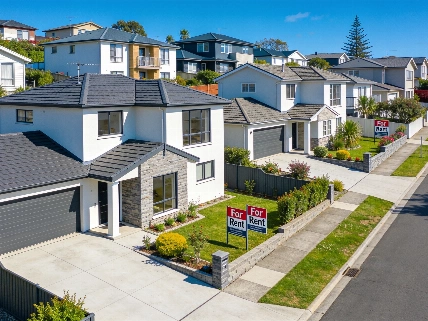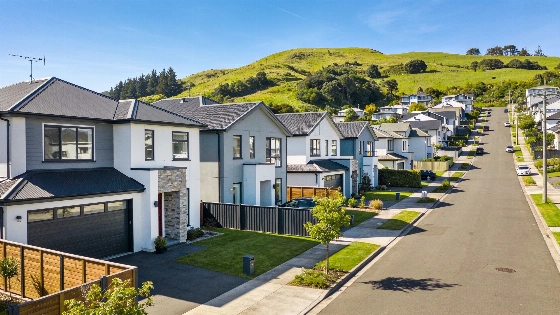
Across most regions in New Zealand, house prices have started to slip, with ANZ New Zealand's economists highlighting higher interest rates as the main reason for the slowdown. The bank's Property Focus report shows the housing market downturn, which set in around mid-2026, has taken hold, especially in the North Island. The Reserve Bank of New Zealand’s November 2026 Financial Stability Report echoes this, noting the market softened over the last six months. Auckland and Wellington remain weak, while the South Island holds up better. Sales volumes have stayed low compared to listings, giving buyers more options and keeping prices soft. The Reserve Bank points to higher mortgage rates, slow population growth, high ownership costs, and plenty of listings as reasons prices are likely to stay subdued for now. Even with recent drops, house prices still sit near the upper end of the Reserve Bank’s estimated sustainable range, so affordability and valuation risks remain in play.
The report details that prices in the North Island are dropping by about 1% to 2% each quarter. In Canterbury, where values had been rising, that trend has now paused. Only a few South Island areas, including Southland and Queenstown-Lakes, still show price growth. The Reserve Bank also notes that demand for new townhouses is reaching its limit in some places. Buyers are leaning toward standalone houses, and some unsold townhouse stock is building up. Regional differences are clear: Auckland and Wellington continue to struggle, while certain South Island markets help offset the national decline.
Interest rates outweigh election effects
ANZ's economists say the upcoming election could have some short-term influence on the housing market, but they expect the effect to be limited. The report mentions that a change of government and the possible introduction of a Capital Gains Tax would likely push prices down further. If a National-led government stays in power, some buyers might return. Still, the report warns, "don't expect any post-election shift to be large though, as interest rates remain the bigger driver of current market trends." The Reserve Bank has also said that higher mortgage rates and some election-related uncertainty have dampened demand, with investor lending growth slowing this year. But the Bank’s view is that monetary and structural housing-market forces matter more than a brief political event.
Buyer demand, measured by sales volumes, has dropped as interest rates have climbed. The report attributes most of the slowdown to these higher rates, with election uncertainty—mainly around tax policy—playing a smaller part. The Reserve Bank expects the average mortgage rate paid by borrowers to rise from about 4.8% to 5.4% over the next year, based on current mortgage rates and market pricing for future rates. This 0.6 percentage point increase (roughly 12.5% above the starting rate) means borrowers refinancing or moving to new fixed terms could face higher repayments, even if the Official Cash Rate changes only slowly. Higher debt-servicing costs can limit how much buyers can borrow, putting more downward pressure on prices and sales activity.
Reserve Bank rate hikes expected
ANZ's economists forecast that the Reserve Bank will lift the Official Cash Rate by 25 basis points on three more occasions, taking it to 3.5%. These hikes are expected to start next month and continue into the following year. The report predicts house prices will keep drifting lower until about mid-2027. The Reserve Bank’s own view is that housing-related risks are present but contained, and the banking system remains resilient under these pressures. In the short term, slow population growth, high ownership costs, and many listings are likely to keep prices soft.
The Reserve Bank also reports that more flexible loan-to-value-ratio (LVR) settings introduced in December 2025 have helped first-home buyers, while investor activity has dropped. This regulatory change has supported some highly leveraged owner-occupiers but hasn't reversed the broader weakness in investor lending or overall market momentum. The impact of these LVR changes stands apart from the effect of interest-rate conditions, which continue to weigh most heavily on demand.
ANZ New Zealand is the country's largest home lender, with total lending of $121 billion as at 30 September. For more on current housing market trends, see the original ANZ Property Focus report.