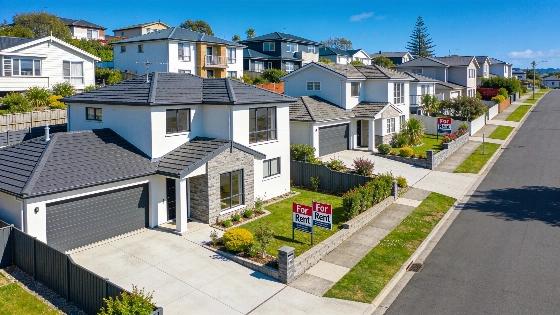
Rents for new tenancies in New Zealand have started climbing again, with data showing a 1% rise compared to the same period last year. This shift comes after a stretch through 2025 when rents on new tenancies had been dropping. The latest figures, highlighted in ANZ’s November/December 2026 Property Focus, show this change appearing in several regions.
ANZ economists point to a gradual economic recovery as the reason for higher rents. They explain that while rising interest rates have pushed house prices down, rents have not seen the same level of pressure. ANZ reports that rent inflation is still well below its long-term average of 3% to 4% per year. Ongoing house building has helped limit rent increases. If the recovery continues, ANZ expects new tenancy rents to rise by 1% to 3% over the next year.
House prices and buyer conditions
Even as rents move up, house prices across the North Island are dropping at a rate of about 1% to 2% per quarter. In Canterbury, earlier price gains have now stopped. The number of unsold properties has reached the equivalent of 29 weeks of sales, the highest since 2014 except for a brief spike at the start of the pandemic. Sales volumes remain low. Real Estate Institute of New Zealand (REINZ) data shows a 23.5% fall in national house sales in October 2026 compared to the previous year. Auckland saw a 30% drop in sales over the same period. ANZ describes the current market as one where buyers hold the advantage.
Political uncertainty is also in play, with the final vote count from the recent election due on Friday 27 November. ANZ notes that a change of government and Labour’s proposed capital gains tax, set to apply from July 2027, could put more pressure on house prices. If a National-led government stays in office, some buyers who have been waiting may return. ANZ expects any post-election change to be limited, with interest rates remaining the main factor shaping the market.
Interest rates and mortgage outlook
ANZ forecasts three more 25 basis point hikes to the Reserve Bank of New Zealand’s official cash rate, starting in December and reaching 3.5%. The bank expects house prices to keep drifting lower until around mid-2027. Not all banks agree on where the cash rate will peak. Bank of New Zealand (BNZ) expects it to reach 3.75% by May next year, with fixed mortgage rates rising by another 20 to 50 basis points by March. For borrowers refixing their mortgages, ANZ reports that six-month and one-year rates have eased since the Reserve Bank’s surprise hold in October. The median six-month special rate across the five largest banks is 4.79%, compared to 4.99% for one year. However, the 20 basis point saving could vanish if the six-month rate climbs by 40 basis points or more at rollover. ANZ’s analysis shows that mortgage rates would need to stay near 6% for three- to five-year fixed terms to be cheaper than one- or two-year fixes on cost alone.
For more details on the current market outlook, see the original coverage at MPA New Zealand.