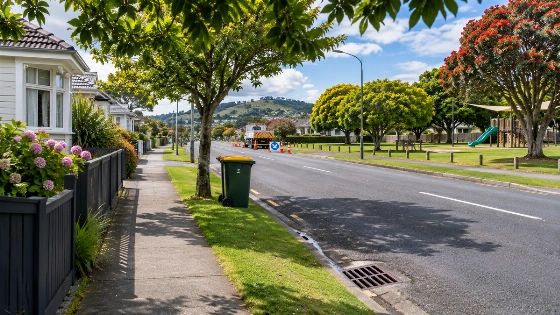
A council rates bill in New Zealand pays for far more than the rubbish truck outside the house. Rates help maintain roads, keep public facilities operating and fund infrastructure that serves entire communities. They are a property tax, not a receipt for services used by one household. What appears on the bill depends on the council, the property's rating details and the services available in its area.
The everyday services rates help fund
Road repairs, footpaths, street lighting and parks are among the visible costs. Council budgets can also cover libraries, swimming pools, waste collection and the upkeep of drinking water, wastewater and stormwater networks where those services fall under council funding. Behind the scenes are flood protection, resource management, environmental monitoring and the cost of maintaining or replacing ageing assets. Some rates revenue also helps meet interest costs on money borrowed for infrastructure.
The proportions vary sharply by place. In its 2026/27 rates breakdown, Gisborne District Council allocates 30% of operational expenditure to roads and footpaths, 16% to liveable communities and 9% to wastewater. Water accounts for another 6%, with stormwater at 3%. The council expects to collect NZ$117.3 million in rates, including GST, during the year. Those percentages describe council-wide operating expenditure, not the exact division of an individual household's payment.
Why the bill contains different charges
A general rate helps pay for services benefiting the wider community. Depending on the council's rating system, it may be based on a property's capital value or land value. Some councils add a uniform annual general charge, a fixed amount charged to each applicable rating unit or separately used part of a property. Targeted rates fund specified activities and can differ according to location, property type or service connection. Wastewater, refuse collection and environmental programmes are examples, but the names and charging rules are not identical nationwide.
Property valuations determine how some costs are shared; they do not independently set the council's total revenue requirement. A revaluation can shift the share paid by one owner compared with another, while an adopted annual budget can change rates even when a property's value stays the same. Fixed charges and targeted rates make the final calculation more complicated than applying one percentage to a home's market price.
Auckland Council's 2026/27 rates information gives a concrete example. For a residential property with the council's average capital value of NZ$1.28 million, annual rates rise from NZ$4,057 to NZ$4,378, an increase of NZ$321 or 7.9%. That example includes general and specified targeted rates, including waste management charges. It is an Auckland benchmark, not a typical bill for every New Zealand home.
Regional rates may be included too
Territorial councils and regional councils have different responsibilities. A district or city council may collect regional rates on the regional council's behalf, or the regional council may invoice separately. Regional funding can support public transport, flood protection, pest control and environmental work, rather than the neighbourhood facilities funded by a city or district.
Waikato Regional Council's rates guidance distinguishes its general rate, uniform annual general charge and targeted rates. Its general rate supports activities including regional transport connections and flood protection. Targeted charges cover specified programmes, with the amount depending on factors such as property value and location.
How to trace the charges on your property
Start with the property's rates assessment, rather than the payment total alone. It identifies the rates and charges applied to that property. The council's annual plan sets out the year's spending and funding decisions, while its long-term plan details longer-running services and projects. Councils also use fees, grants, subsidies and borrowing, so rates are only one part of their funding.
If a targeted charge looks unexpected, the property classification, number of separately used units and recorded connections for water or waste services are worth checking against the council's assessment. Those details can change which charges apply, even to properties on the same street.