An Auckland rental can look suitable at a viewing yet come with costs or restrictions that become clear only after the tenancy agreement arrives. Before signing, check the property, upfront costs and contract terms. The Residential Tenancies Act 1986 applies nationwide, but Auckland properties vary widely.
Inspect the home, not just the floor plan
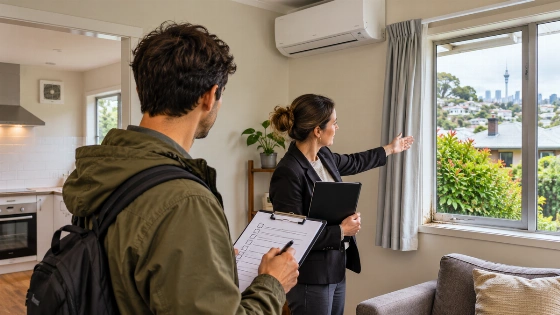
Look around window frames, ceilings and wardrobes for mould, stains or a persistent damp smell. Open windows, test taps and check that doors lock properly. Ask whether the main living room has a working fixed heater and whether kitchen and bathroom extraction fans operate. Look for signs of leaks around gutters and beneath the house.
Since 1 July 2025, private rentals have been required to meet the Healthy Homes Standards unless a specific exemption applies. These cover heating, insulation, ventilation, moisture and drainage, and draught stopping. Tenancy Services provides a practical tenant inspection checklist. The landlord must supply a signed compliance statement with the tenancy agreement, including details of the property's current compliance.
Ask what appliances and fittings stay with the home. Curtains, a fridge or a washing machine shown during a viewing should appear on the chattels list if they are included. Take dated photographs and complete a condition report with the landlord when the tenancy begins. Record existing damage before moving in.
Calculate the full cost of moving in
For a standard tenancy, a general bond can be no more than four weeks' rent, while a landlord cannot demand more than two weeks' rent in advance. At an advertised NZ$700 a week, the maximum general bond is NZ$2,800. Adding two weeks' advance rent brings the initial payment to NZ$4,200, before moving costs or utility connections. This is an example, not a market-rent estimate.
Letting fees and key money are prohibited. When a landlord receives the bond, it must be lodged digitally with Tenancy Services within 23 working days. Keep the payment record and bond confirmation. From 1 December 2025, landlords may also charge a separate pet bond of up to two weeks' rent when consenting to a pet, subject to the applicable rules. Disability assist dogs are exempt from those consent and pet-bond requirements.
Rent is only part of the cost. Check whether water charges apply, who pays for electricity and internet, and whether a parking space is included. In apartments, check any extra parking or storage fees.
Read the term and the fine print
The written agreement should state the rent, payment frequency, start date, named tenants, bond and any fixed-term end date. It must also include required healthy homes and insurance information. The official Tenancy Services guidance sets out the essential details. Check occupancy, garden care and smoking conditions in writing.
A periodic tenancy has no set end date; tenants generally need at least 21 days' written notice to leave. A fixed term normally cannot be ended early without agreement or other limited legal grounds. At the end of a fixed term, it usually becomes periodic unless the required notice is given during the period from 90 to 21 days before expiry or another permitted arrangement applies. Rent increases generally require at least 60 days' written notice and cannot take effect within 12 months of the tenancy starting or the previous increase.
Pets also deserve a written discussion. Under the rules effective from December 2025, landlords may refuse a pet request only on reasonable grounds and may set reasonable conditions. For a unit-title apartment or townhouse, ask for the body corporate rules. They may address noise, rubbish, shared facilities and parking, and the landlord must provide applicable rules with the agreement.
Check the Auckland address itself
A weekend commute may look easier than a weekday one. Test the journey at the hours it will actually be made, including transfers and walking distance to the nearest bus or train stop. For households with a car, establish whether parking is on-site, assigned or restricted on the surrounding streets.
Flood exposure merits a separate check. Auckland Council's Flood Viewer maps floodplains, flood-prone areas and overland flow paths, as well as coastal inundation. The map shows risk, not a guarantee. Ask about previous water entry and inspect ground-floor rooms, garages or basements accordingly.
Before handing over money, confirm the property address and the landlord or property manager's payment details. Keep the signed agreement, receipts, inspection report and photographs together. Record promised repairs and deadlines in writing.