A weekly supermarket bill is a fair comparison only when it covers the same food in quantities a household will actually use. A cheaper-looking trolley might contain smaller packets or fewer meals, while a member-only offer may not apply to every shopper. For families comparing PAK'nSAVE, New World and Woolworths in New Zealand, the starting point is a consistent shopping list rather than a store's advertised specials.
Build one basket and keep it comparable
Write down the usual amounts of milk and bread, then add the eggs and vegetables needed for the week's meals. Compare the same brand and pack size where possible. If a cheaper home-brand substitute is acceptable, use that rule at every supermarket. Otherwise, one store can appear to win simply because its basket contains different products.
Choose the actual branches that are practical to visit. Prices and promotions can differ between stores, and an online comparison should use the same week and a clear collection or delivery option. A basket made from Wellington prices is not automatically a fair guide to a household shopping in Dunedin. Note when each price was checked, because specials can change before the next shop.
Compare unit prices, not packet sizes
The number beneath the shelf price is often the most useful one. A unit price shows the cost per standard measure, such as per 100 grams or per litre. Under New Zealand's grocery unit pricing rules, covered large physical supermarkets have had to display unit prices since 31 August 2024. Covered online grocery retailers have had to comply since 31 August 2025. The requirement does not extend to every small shop.
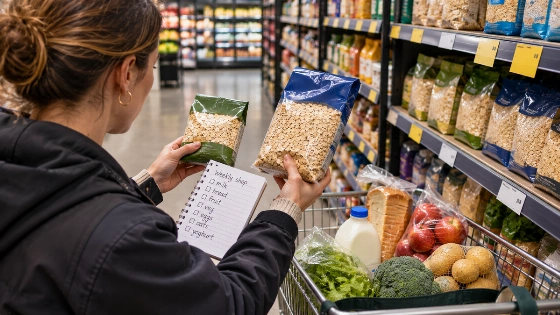
Consider two hypothetical packets of rolled oats. A 500g bag costing NZ$4 works out to 80 cents per 100g. A 750g bag costing NZ$5.25 works out to 70 cents per 100g. The larger bag offers better value by weight, but still requires NZ$1.25 more at checkout. Those are calculation examples, not current supermarket offers. If the extra oats go unused, the apparent saving has little value.
Compare like with like. A bag of apples and loose apples can be assessed by weight, but ripeness and quality matter. With canned food, consider how much usable food remains after draining. Multipacks are not necessarily cheaper per item, and bulk bins are not automatically better value than packaged goods. Check that labels use the same measuring unit before deciding.
Check loyalty prices and genuine specials
Consumer NZ's June 2026 supermarket comparison tracked a 16-item basket across 12 stores in Auckland, Wellington, Christchurch and Dunedin. Prices were collected over eight weeks between February and April. PAK'nSAVE had the cheapest basket in all four cities, averaging NZ$84.38. That was about NZ$5 less than the average basket for New World and Woolworths loyalty members. New World shoppers without membership paid about NZ$97 on average.
These results describe the products and stores surveyed, not a guaranteed saving on every family's shop. The basket excluded fresh meat and produce because assessing comparable quality would have required more work. Consumer NZ also found some member specials were still dearer than another chain's regular prices. A loyalty discount should therefore be compared with the lowest accessible checkout price elsewhere, not simply with the crossed-out price beside it.
A yellow special label is not proof of a bargain. For products bought regularly, keeping a short price history makes it easier to recognise a meaningful discount. Multi-buy promotions deserve the same scrutiny: calculate the price per unit, then ask whether the household needs every item. The Commerce Commission's retail pricing guidance says advertised price claims must be clear and accurate, and shoppers should normally expect to pay the displayed shelf price at checkout.
Work out what the full shop costs
Compare the final basket total after applying discounts available to that particular household. For online orders, add any collection or delivery charge. Splitting the shop across two supermarkets makes sense only when the saving outweighs the extra travel and time. A smaller household may also benefit more from buying the amount it can finish than from choosing a cheaper price per kilogram on an oversized pack.
Keep the receipt and compare it with the shelf or online prices recorded for the week. If a promotion fails to appear at checkout, ask the retailer to check the transaction. For the next shop, update the prices of frequently purchased items rather than treating one week's winning supermarket as permanently the cheapest.